
Forgive Us Our Debts: How to Forgive Someone Who Hurt You | Matthew 6:12
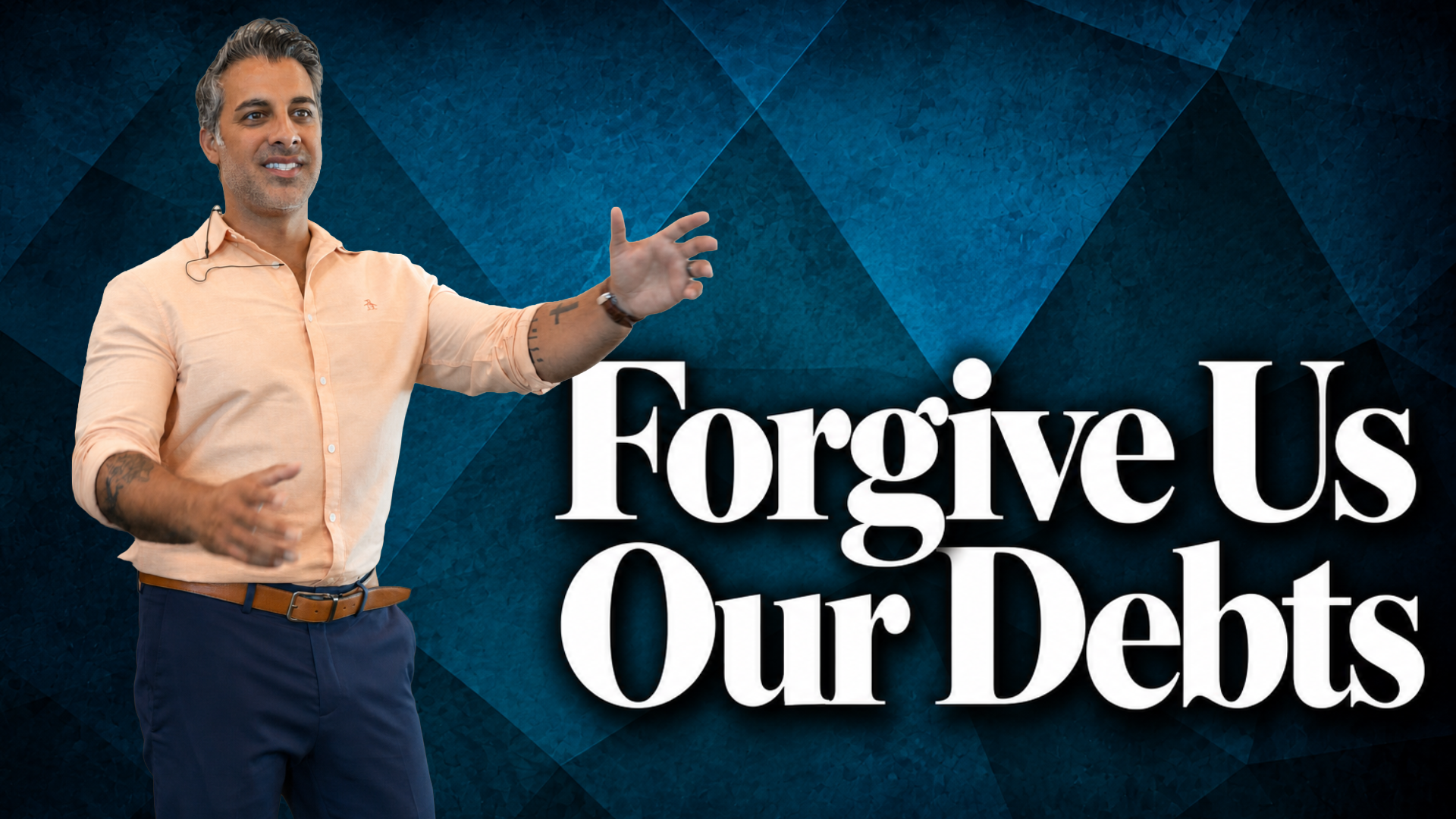
Pastor Rajiv Khatri preaches Forgive Us Our Debts from Matthew 6:12, 14–15 at Belvedere Church in West Palm Beach.
Forgive Us Our Debts
You want to forgive someone who hurt you, but letting go feels like saying the hurt did not matter. Jesus teaches us to bring that debt to a Father who saw what happened and has not forgotten.
In this message from September 13, 2026, Pastor Rajiv Khatri continues the Kingdom-Centered Prayer series at Belvedere Church, a Christ-centered West Palm Beach church, with Matthew 6:12, 14–15. We owe God a debt we cannot repay. Through His death and resurrection, Jesus brings us forgiveness and welcomes us into the Father's family.
Forgiven children still confess their sins. We come to God with the truth about what we said, what we did, and whom we hurt. His mercy also changes how we treat the people who have sinned against us. Forgiving others is evidence that we have received His grace; it cannot purchase our salvation.
Pastor Rajiv names the pain of an apology that never came, a reputation someone damaged, and a wound we keep revisiting. Forgiveness means surrendering personal vengeance and entrusting justice to God. It does not require pretending the harm was small or returning to an unsafe relationship. When the memory returns, we can ask our Father for help and choose forgiveness again.
Key Takeaways
Sin is a debt we cannot repay. Jesus paid what we owed through His death on the cross.
Forgiven children still confess. Bring specific sins to your Father with honesty and confidence in His mercy.
God's forgiveness comes first. We extend mercy because, in Christ, God has forgiven us.
The hurt matters to God. You do not have to hold on to bitterness to prove that He saw what happened.
Struggling to forgive differs from refusing. Keep bringing your struggle to God and asking Him to change your heart.
Forgiveness is a decision you may need to repeat. Surrender personal vengeance even when your feelings have not caught up.
Forgiveness and reconciliation are different. Forgiving someone does not mean abandoning justice or giving an abuser access to you.
Practice mercy in ordinary church life. Ask God for help with the person you avoid, the grudge you rehearse, or the story you repeat to make someone pay.

Closing Application
Name the person you need to forgive and what the hurt has cost you. Tell your Father the truth about it. Ask Him to help you surrender personal vengeance and entrust justice to Him.
Remember what Jesus paid to forgive you. Ask for help to stop using the hurt to punish the other person through your words, gossip, or rehearsed resentment. Forgiveness does not require returning to an unsafe relationship. When the memory returns, bring it to God again.
Sermon Transcript: Forgive Us Our Debts
Pastor Rajiv Khatri | September 13, 2026
Matthew 6:12, 14–15 | Belvedere Church, West Palm Beach, Florida
Edited for readability from the sermon recording. Repeated phrases, timestamps, and verbal stumbles have been removed.
Opening Prayer
In this place, we adore You. We give You all praise. Help us continue to praise You and worship You in every area of our lives. Lord, help us to live for You in all areas.
God, we love You for all that You have done for us through Your Son, Jesus Christ: the shedding of His blood at the cross for the forgiveness of sins, and raising Him from the dead so that we could be made right with You, receive mercy, and receive grace.
God, we love You, and we worship You always, in the name of Jesus. Amen.
Forgive Us Our Debts | Matthew 6:12, 14–15
You may be seated. I am battling a little bit of a sore throat, so if I struggle throughout the sermon, I apologize in advance. I want to get the prayer we have been going through up on the screen. Church, say this prayer with me this morning:
“Our Father in heaven, hallowed be your name. Your kingdom come, your will be done on earth as it is in heaven. Give us today our daily bread. And forgive us our debts as we also have forgiven our debtors. And lead us not into temptation, but deliver us from the evil one.” Amen.
I want you to hear the middle line one more time: “And forgive us our debts as we also have forgiven our debtors.”
Jesus teaches this whole prayer. He finishes it, and then He does something He does not do with the other lines. He goes back, picks out this one line, and says more about it. He does not do that with “Hallowed be your name” or “Your kingdom come.” He does it with this line.
In Matthew 6:14–15, He says, “For if you forgive other people when they sin against you, your heavenly Father will also forgive you. But if you do not forgive others their sins, your Father will not forgive your sins.”
There is a tension there that we are going to address. First, notice what Jesus did. In verse 12, He uses the word debts, the language of money, something owed to someone else. Two verses later, He says sin, and He tells you whose sin: when they sin against you.
The debt Jesus is talking about is sin. The sin you have committed against God, the sin you have committed against somebody in your life, and the sin somebody has committed against you. We have to understand our debt to God before we can understand our relationship with one another.
Our Debt to God
I think the church has gone soft with the word sin. I am talking about the church everywhere. Most of us do not mind calling our sin a weakness. We are fine with the words mistakes or broken. We are broken, and we are weak, but those words can let us off too easily.
A debt is something you owe. You can regret a mistake or a bad decision and move on. You cannot regret a debt away. It sits there. Sorry does not clear it.
Jesus uses debt as a picture of sin, and how much you owe depends on whom you owe it to. The consequence of sin is proportionate to the power and authority of the one against whom you have sinned.
Take lying as an example. Every person in this room has lied. If you lie to a friend, you might lose a friend. Increase the power and authority: lie to your boss, and you could get fired. Lie to the government on your taxes or a federal form, and now you might find yourself in a courtroom facing prison.
The sin is lying. The person you lied to has changed. The greater the authority, the greater the consequence.
Now consider lying to the eternal God, the One who made you, who has given you every breath you have taken, and who has never once lied to you. The consequence of sin against the eternal God is eternal death. That is no small debt.
A debt like that does not disappear. Somebody pays it or somebody absorbs it. That is how debts work.
Coming to Our Father
Look at who Jesus says can pray this. Go back to the first line: “Our Father.” Church, He is walking you into a home.
If you are new this morning or new to the faith, I want you to understand this because it can cause confusion. When you first heard this verse, you may have wondered whether you have to forgive everyone who has wronged you before God will save and forgive you.
When you come to faith in Christ, the verdict comes in: not guilty. It never comes back up. Romans 8 tells us, “Therefore, there is now no condemnation for those who are in Christ Jesus.” If you are in Christ, you are no longer under the penalty of sin. You have been forgiven.
If you have not placed your faith in Jesus, you still owe a debt. God is ready to forgive you today if you will come to Him and give Him your life.
So why do we still ask for forgiveness when we are in Christ? A boy who disobeys his father does not stop being his son. Nobody takes his name away. He is not on trial. But he still walks in and says, “Dad, I did that. I was wrong. Forgive me.”
He loves his dad, and love will not let him stand there pretending nothing happened. That is what this verse is: a child coming to his Father and telling the truth.
Confess What You Actually Did
Telling the truth means saying what you did. I am not talking about a safe, generic confession. Most of us have a sin we confess regularly, and we keep it safe: “Lord, forgive me for my pride.” It sounds spiritual. Everybody struggles with pride, and nobody has to know what you did.
I am talking about getting specific: “God, forgive me for what I said to my wife on Tuesday night. Forgive me for the tone I used. Forgive me for wanting to win more than I wanted to love her. Before I sinned against her, I sinned against You. Forgive me for that.”
Hear the difference. That prayer changes a man.
There is a reason this line sits next to “Give us today our daily bread.” Then comes “And forgive us our debts.” The same breath, the same frequency, the same open hand.
Last week we learned that you do not have to stockpile bread. You do not have to stockpile God's mercy either. You come to Him daily, and He has plenty to give you daily.
First John 1 says that if we confess our sins, He is faithful and just to forgive us and purify us from all unrighteousness. Every morning you come to the Father because forgiven children still confess their sins. You do not need to get saved again. The mercy Christ purchased for you never runs out.
We Forgive Because God Forgave Us
I know some of you are looking at the second half of the verse: “As we also have forgiven our debtors.” You may still hear it like a game show, as if God were saying, “You go first. Forgive enough people, and then I will forgive you.”
Follow that thought through. A man who has been hurt by many people has many people to forgive, so he has a long way to go before God will hear him. A man whose life has been easy has nobody to forgive, so he is fine. Would that mean the more you have suffered, the farther you are from God? That cannot be right.
Look at the word Jesus uses: “As we have forgiven.” You become a forgiving person when you receive forgiveness from God. It marks a Christian who is growing, even though that person is not perfect. We forgive because God first forgave us.
Paul says it with clarity in Ephesians 4: “Be kind and compassionate to one another, forgiving each other, just as in Christ God forgave you.”
Understand the order. God already did it. Your forgiveness comes after His and because of His. Your forgiving does not buy God's forgiveness. It comes out of a person who has already been forgiven. Forgiving others is evidence that God's mercy has reached your heart.
Mercy received turns into mercy given. Except we do not always do that, do we? We do not want to forgive people who hurt us. You know God forgave you. You believe it. You tell others about His forgiveness. Then you think about your sister who hurt you, and you cannot forgive her.
The Servant Who Would Not Forgive
Jesus told a story about a man like that. A king calls in his debts, and a man comes before him who owes ten thousand bags of gold. That is more money than he could see in a thousand lifetimes. Everybody in the room knows he cannot pay it back.
The king orders that the man, his wife, his children, and all he has be sold to repay the debt. The man falls to his knees and begs the king for patience. The king releases him from the whole debt. All of it is gone.
The man walks out of the palace free. On his way out, he sees a fellow servant who owes him a hundred days' wages. He grabs him by the throat and starts choking him: “Pay me what you owe.”
A hundred days' wages is real money. If a man owed you four months of your pay, you would not call that nothing. Jesus never says it was nothing. Justice is right and good. The problem is that this man took the king's mercy and refused to give any away.
Church, that is us. We want the blood of Jesus Christ to cover our debts and our sin, and we want the man who owes us to pay every cent. This servant heard the forgiveness and the mercy. It never reached his heart. It did not change him.
Praying With an Honest Heart
Look at the prayer again. “Hallowed be your name. Your kingdom come. Your will be done. Give us bread. Lead us not into temptation. Deliver us from evil.” In each of those lines, you make a request.
There is one line where you say something about yourself: “As we also have forgiven our debtors.” That is a claim. You stand before God asking for mercy, and you tell Him that you have already given it to others.
Every one of us said it out loud this morning. Some of you prayed it in your kitchen before coming to church. You meant the first half, “Forgive us our debts.” Then you moved to the second half without thinking about the man you will not speak to, the sister you have not called in four years, or the woman in church you walk the other way to avoid.
There is a grudge, bitterness, or anger you are holding on to. Maybe you think, “I would never have done what they did.” That reminds me of the Pharisee in Luke's Gospel.
The Pharisee stands in the temple and says, “God, thank You that I am not like other people: greedy, a cheat, an adulterer, or like that tax collector.” Jesus says the tax collector went home right with God. The Pharisee did not.
Being proud that you are not greedy or a cheat exposes another sin in your own heart. We can stand over someone else's wrongdoing with pride that we would never do the same thing.
Let me get real for a moment. I am not better than him. You are not better than her. Without God's grace, I could be where that person is. Given the circumstances, I might do what that person did, or worse.
Three hundred years ago, a pastor named Hopkins said that a person who prays this with that posture is cursing himself. He is asking God, “Treat me the way I am treating him.” Think about what we are saying when we pray these words.
God Saw What Happened
The question remains: why can we not let go? Why can we not forgive? I want to say this carefully, because for some of you this may be the heart of it.
You hold on because it is all you have left. Somebody did not let you say goodbye to a loved one. Somebody owes you real money, and you have been trying to collect it for years. Somebody told a story about you that was not true, and people believed it. Somebody took your marriage, the childhood you should have had, or your reputation, and you never got it back.
For some of you, the wound is the only proof left that it happened, that it mattered, and that you are not crazy. Letting go feels like saying it was nothing. You hold on because holding on feels like the last way to say it was a big deal.
Underneath that, I think you have forgotten that your Father loves you. A man who knows he is loved does not need to hold on to a wound to prove that it matters or that he matters.
Whatever wrong someone did to you, God saw it. He saw every bit of it. He was there when it happened, and He has not forgotten one second. You are not the only one who remembers. You do not have to keep the record.
A Pastor's Own Need for Mercy
There is a man in my neighborhood who said crude and vulgar things around my kids. It made me angry. I could have forgiven him, and I did not. I talked about him more than once. I told myself I was protecting my family. I was making him pay.
I would like to tell you that I have made it right. I have not. I am not preaching as a man who has mastered this or figured it all out. This sermon convicts me too. I have to go make it right.
Some of you have been trying to forgive somebody for years. You have prayed about it, lain awake over it, and gotten up to try again. When I read verse 15, it scared you: “But if you do not forgive others their sins, your Father will not forgive your sins.” You think it means you are not forgiven.
Hear this: struggling to forgive is not refusing to forgive. I struggle sometimes too. Jesus warns the person who says, “I am keeping this debt, and I will not let it go.” If you still desire to forgive and keep fighting that struggle, that indicates spiritual life. Dead men do not fight.
Forgiveness and Reconciliation
You do not have to feel forgiveness first. Forgiveness is a decision to give up your personal right to vengeance and entrust justice to God. If you wait until you feel like it, you may never do it.
You make the decision to forgive. Tomorrow the memory of what they did will come back, and you make the decision again: “I forgive this person.”
Right now, think about the person you need to forgive. Think about the name and the face. Then name what that person took from you. What debt do they owe? An apology you never got? A reputation? A marriage? A childhood? The right to feel safe in your own home?
Forgiving that person does not mean handing them a key to your house. Forgiveness and reconciliation are connected, but they are different. I am not telling you to reconcile with an abuser or pretend justice does not matter. I am talking about surrendering your personal vengeance to God.
Name the person and what they owe you. It becomes hard to surrender something you will not name.
Jesus Paid Our Debt
Maybe you have the name and the debt in your mind, and you still think, “I am the man with my hands on that fellow servant's throat. I know what he owes me. I do not know how to let go.”
Debts do not disappear. If somebody breaks something in your house, the cost does not float into thin air. Either they pay for it, you pay for it, or it stays broken on the floor. Somebody carries the cost. A debt gets paid or somebody absorbs it.
So who paid yours?
Matthew has shown us Jesus teaching about debts, mercy, and the kingdom. Then, on the night before the cross, Jesus sits at a table with a cup and says, “This is my blood of the covenant, which is poured out for many for the forgiveness of sins.”
Do you understand what this means? Forgiveness cost God. When He forgave you, He did not wave His hand at sin, say it was not that bad, or lower the number. Forgiveness is free to you, but it was not free to God.
They drove nails through hands that never took anything from anybody. Jesus never lied, stole, or cheated a man out of a dollar. He never needed to pray, “Father, forgive me for my debts.” He hung on a wooden cross and paid what you owed.
That bill had my name on it and your name on it. It included the thing you did that nobody in this room knows about, the thing everybody knows about, and the man you talked about behind his back. Jesus paid for all of it in full. You and I walk out as free men and women without putting up a dime.
Maybe letting go of what someone owes you feels like it will cost something. You are right. It will. It cost Him too. God did something expensive for you. He asks you to extend what He gave you.
You do not have enough forgiveness in your own supply. I do not either. You are handing out what somebody handed to you. Forgiven people are able to forgive.
Practicing Forgiveness
Let me close with a story. In 2006, a man walked into an Amish schoolhouse in Lancaster County, Pennsylvania, and shot ten girls. Five died, and then he killed himself.
That same day, Amish families went to the killer's family. They went to his widow, his mother, and his father and told them they forgave him. A grandfather, standing over the body of his granddaughter, told the young men in his family that they must not let hate get into them.
About thirty Amish people went to the man's funeral. When photographers showed up, they stood around his widow so the cameras could not get to her. They eventually set up a fund for his children.
How does a person respond that way to something so horrific? They did not decide it all in one morning. They had received mercy and spent their lives extending it. They had learned to practice forgiveness in their families, their church, and the ordinary hurts of living beside one another.
When something terrible happened, they extended what was already in them. They said later that forgiveness remained a decision they had to keep making. It did not show up once and settle everything. They kept choosing it.
Forgiveness in the Church Family
That is what church should be. Hear the words again: “Forgive us our debts as we also have forgiven our debtors.” There is no I in this prayer. Even when Jesus teaches you to pray alone, He teaches you to pray as part of a people: our Father, give us, forgive us, lead us.
Some of the people you need to forgive may sit in the chairs near you. They may be praying this with you right now. I want us to be a church where forgiveness comes out when somebody gets hurt. We can choose mercy instead of the cold shoulder, the phone call to somebody else, or eighteen months of walking the other way in a parking lot.
That starts now, in small things, perhaps with the person two rows over.
Taking the Hurt to God
This week, take it to God. Say it out loud to Him: “Father, this is what he did to me. This is what it cost me. I am not calling it small. I am not calling it nothing. I am not collecting anymore. God, I am handing it over to You.” Then forgive that person.
Stop bringing it up to that person to hurt them. Stop bringing it up to other people to make them look bad. Stop bringing it up to yourself at eleven o'clock at night to keep the fire going in your heart.
You will have to do it again. The memory will come back tomorrow, and tomorrow you will make the decision again: “I forgive him.”
You and I owe God more than we could count or imagine. We could not pay a penny of it. He paid it Himself, and it cost Him His Son.
In the story about the king, one question remains. He turns to the servant and asks, “Shouldn't you have had mercy on your fellow servant just as I had on you?” Carry that question with you this morning.
You and I have been forgiven. So forgive that person. Remember, a person who has been forgiven forgives. Let us forgive. Let us pray.
Closing Prayer
Father, there may be many of us, perhaps all of us, who have somebody we ought to forgive. We know it is not easy. You never said it was easy.
Forgiveness comes at a cost. Somebody pays the debt or somebody absorbs it. God, You sent Your Son Jesus to take our debt upon Himself so that we could be forgiven.
Lord, help us extend that mercy and forgiveness to those who have sinned against us. Forgive us our debts. Forgive us our sin as we also have forgiven our debtors. Amen.
West Palm Beach Church
Belvedere Church is a Christ-centered West Palm Beach church where you can hear God’s Word and grow with a church family shaped by Scripture and the Spirit. In this message from Matthew 6:12, 14–15, Pastor Rajiv Khatri explains how the forgiveness Jesus purchased at the cross changes the way we respond to people who hurt us. Bring your questions, your struggle, and your need for grace.
Join us Sundays at 11:00 AM at 301 Cherry Road, West Palm Beach, FL 33409. Plan your visit to Belvedere Church or explore more sermons.